
Children's Swimming and Swim Schools: What Is Already Happening and What Will Intensify in the Years Ahead
- Jul 21
- 3 min read

Our recent international journey—through Cascais (Portugal), Elche, and Benidorm (Spain), attending industry events and visiting leading institutions—was, above all, an opportunity to build meaningful connections between practice, science, and a forward-looking vision for children's swimming and swim school management.
At the 4th ISSA (International Swim Schools Association) Conference, we had the opportunity to witness firsthand how the industry is evolving on a global scale. Sandra Rossi Madormo's participation as a speaker highlighted the relevance of the knowledge we have developed in Brazil, while my involvement with the ISSA leadership group further expanded my understanding of the strategic directions shaping our industry. One aspect that stood out was the steady advancement of scientific evidence in lesson design and the increasing use of technology in swim school management.

Multinational team responsible for ISSA's strategic planning for the next three years, with Rafaele representing South America.
Within this context, it is becoming clear that swim schools are entering an important transition: moving from a traditional service-oriented model toward a new frontier—hospitality. As expressed in the book Unreasonable Hospitality (which served as the foundation for one of the conference's most compelling presentations), "Service is black and white. Hospitality is color." This shift in mindset will have a direct impact on the experience of students, families, and the way swim schools position themselves in the marketplace. Combined with the growth of large national and international swim school networks, it points to a significant rise in the industry's competitive standards over the short and medium term, depending on the maturity of each market.
At Miguel Hernández University of Elche, we were welcomed by Professor Juan Antonio Moreno Murcia, in a visit that reinforced the value of applying scientific research to our daily practice. We had the privilege of witnessing a special moment: the professor's emotion as he received the first printed copies of his new book, MAC – Método Acuático Comprensivo (Comprehensive Aquatic Method), which he described as the culmination of a lifetime devoted to advancing knowledge in the field. More than an institutional visit, it was an immersion into an environment where research is driven by a clear purpose—to directly improve professional practice.
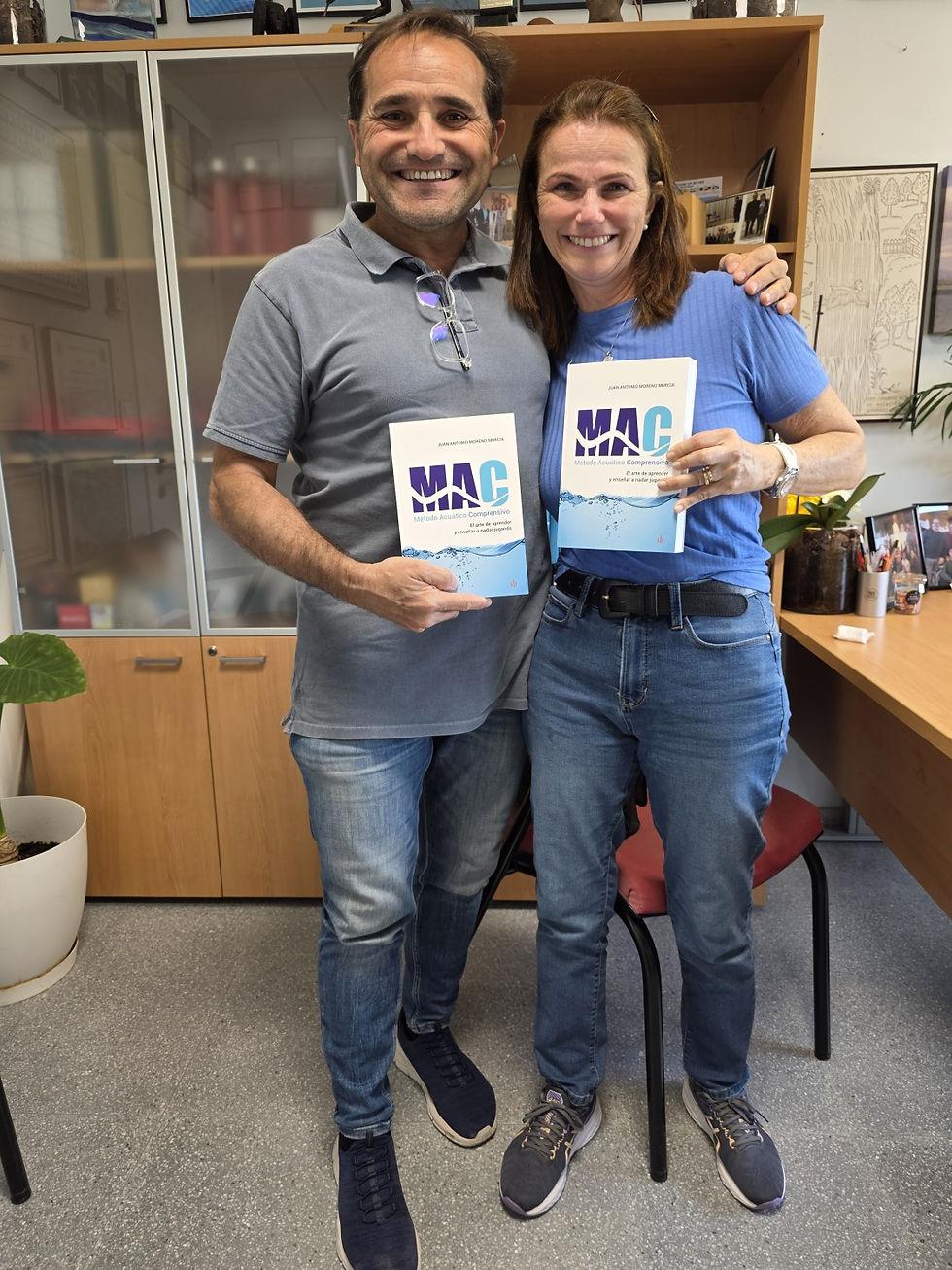
Dr. Juan Antonio Moreno Murcia with Sandra and the first copies of his new book.
Concluding this journey, the Aqua Baby event, organized by AIDEA (Ibero-American Association for Special Aquatic Education and Hydrotherapy), provided a highly consistent perspective on translating scientific evidence into everyday teaching practice. Once again, Sandra contributed as a speaker, addressing topics ranging from communication with babies to respectful immersion practices. The event highlighted an increasingly strong movement toward science-based swimming instruction, emphasizing respectful teaching methods and safety at every age—especially for babies and young children—by understanding their emotions, respecting their individual limits, and avoiding any forced execution of activities.

Sandra delivering one of her presentations at Aqua Baby.
This continuous professional development is essential. It keeps us connected with the most relevant global advances while allowing us to bring best practices back to Brazil. At the same time, it gives us the opportunity to share the expertise we have built over decades—expertise that is fully aligned with the most modern concepts currently being applied internationally.
We continue to learn, contribute, and strengthen bridges across our global community. Because the future of children's swimming is built this way: through knowledge, connection, and purpose.
Rafaele Madormo
Executive Director, INATI


Comments