
From Mexico to Brazil: signs of transformation in the swimming school market
Observations and reflections from a recent trip to Mexico.
Rafaele Madormo
Being in Mexico alongside Sandra Rossi Madormo to participate in the 42nd Nelson Vargas Swimming and Fitness Congress was also an opportunity to look more closely at a swimming school market that, in many ways, shares similarities with the Brazilian one.
The congress brought together about 700 participants. A number that, in itself, already draws attention. But another figure perhaps says even more about the scale of Nelson Vargas: approximately 500 participants were teachers from the company itself.
Nelson Vargas has a history of about 48 years and has become a powerhouse in the Mexican market. Founded by Nelson Vargas, a true sports legend in Mexico, the company maintained an eminently family-run characteristic for decades, led by the founder and his two children.
Earlier this year, however, it took an important step toward professionalizing its management by bringing Pere Solanellas, a well-known sports market consultant, from Spain to take on the role of CEO. It is a move that particularly caught my attention. Many companies in our sector are born from the technical competence, vision, and hard work of their founders and grow while maintaining family management. At a certain point, however, growth itself may require a new management structure.
During our time in Mexico City, we also had the opportunity to visit the company's 18th branch, Nelson Vargas Family Fitness in Polanco, which opened its doors on August 24th.
The project, designed by Brazilian architect Patricia Totaro, is a colossus, spanning approximately 11,000 square meters. More than its size, it is impressive to note the investment made and the scale that a company originally linked to swimming has managed to achieve over nearly five decades.
Getting to know an operation of this scale is interesting because it makes us look beyond the pool. Infrastructure, management, team training, customer relations, service diversification, and investment capacity all become part of the same equation.
Also in the Polanco neighborhood, we visited a branch that opened four months ago by Club Cañada, a company with seven locations. There, we found an operation exclusively dedicated to swimming, with around 1,500 students, located inside a shopping mall.
A visual comparison helps to understand its dimensions: the school occupies a space roughly equivalent to that of a Smart Fit gym located next door.
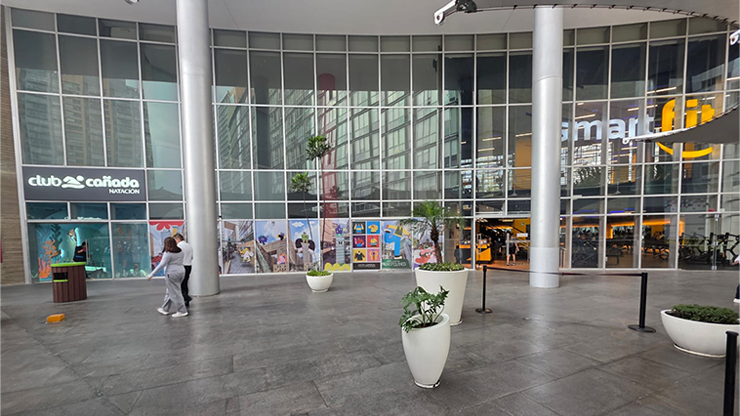
What caught my attention the most, however, was not just the physical infrastructure. Club Cañada features a modern customer service concept, making heavy use of technology and kiosks where customers themselves can purchase classes and products.
This is hardly new when we look at more developed swimming school markets, such as the United States and Australia. What I find interesting is starting to see these solutions incorporated into operations in countries like Mexico, which have an economic and business reality closer to our own.
It is a trend worth following. Technology is already present in Brazilian swimming schools, naturally, but I believe that in the coming years, we will see it being used much more effectively in the customer journey, sales, service, and the operations of the schools themselves.
This, by the way, was not our first opportunity to observe the Mexican market.
Last year, we were in Boca del Río, in the state of Veracruz, participating in another event, more modest in its characteristics but of great academic value. That trip put us in touch with a different reality, made up of smaller, more traditional schools. This time, in Mexico City, we had the opportunity to see operations of a different magnitude.
Combining these two experiences gives us a sharper view of the Mexican market. There isn't just a single reality. Alongside large companies, sophisticated facilities, and professionalization trends, there are still smaller, traditional schools that are very similar to what we find in many regions of Brazil.
Sandra participated in the congress program as a speaker, presenting three topics: aquatic safety, swimming for atypical children, and the influence of the vestibular and limbic systems on learning to swim. I also participated in the entire event program, attending the lectures and taking advantage of the breaks and networking moments to talk with professionals and entrepreneurs in the sector. The visits to the Nelson Vargas and Club Cañada locations were made in the days leading up to the congress and perfectly complemented what we were able to observe and discuss during the event.
Besides actively participating in the congress, my trip to Mexico also had other objectives: to broaden my understanding of the Mexican market, talk with its key players, and establish new contacts with the next INATI Inspira in mind, which will take place from April 1st to 4th, 2027, especially for the S4 – Swim School Strategic Summit. Being at an event with around 700 professionals and, at the same time, getting to know some of the country's main operations made this combination particularly interesting.
And perhaps this was the main takeaway from the trip.
The Mexican swimming school market has many similarities to the Brazilian one. There are family businesses that have grown, operations of different sizes and proposals, a concern for professional training, and a sector that is starting to incorporate new technologies and ways of relating to its customers.
Therefore, observing what is happening there is not just a curiosity about another country. It can be an interesting reference point for us to understand trends that we are also starting to experience in Brazil.
This doesn't mean that the exact same models will be replicated here. Each market has its own characteristics, culture, and particularities. But looking outward helps us ask questions about what we are doing internally.
What will Brazilian swimming schools look like in a few years? How big could some of them get? What will be the role of technology? How will customer expectations change? And what skills will be necessary for those leading these companies?
I returned from Mexico with some confirmations, many contacts, and a few more questions.
For those who work in management, perhaps this is one of the most interesting things about traveling and getting to know other markets: observing what is happening elsewhere helps us better see trends that are also happening here, often in different ways and at different paces.


Comments